The quest for general-purpose robotics has historically been bottlenecked by one fundamental constraint: data. While large language models and computer vision systems have thrived on the abundance of internet-scale data, physical AI systems require a different kind of training signal. They need data that encapsulates not just what things look like, but how things move, interact, and manipulate the physical world.
This is where egocentric data—specifically first-person human video—emerges as a critical pillar for the future of robotics. By capturing the world precisely as humans experience it during manipulation tasks, egocentric video provides a rich, scalable, and highly contextual data source that bridges the gap between passive observation and active physical interaction.
In this article, we will explore the definition and components of egocentric data, examine its benefits for robot learning, dissect its limitations, and discuss how it harmoniously complements traditional robot-collected data to build more robust physical AI.
What Does Egocentric Data Mean in Robotics?
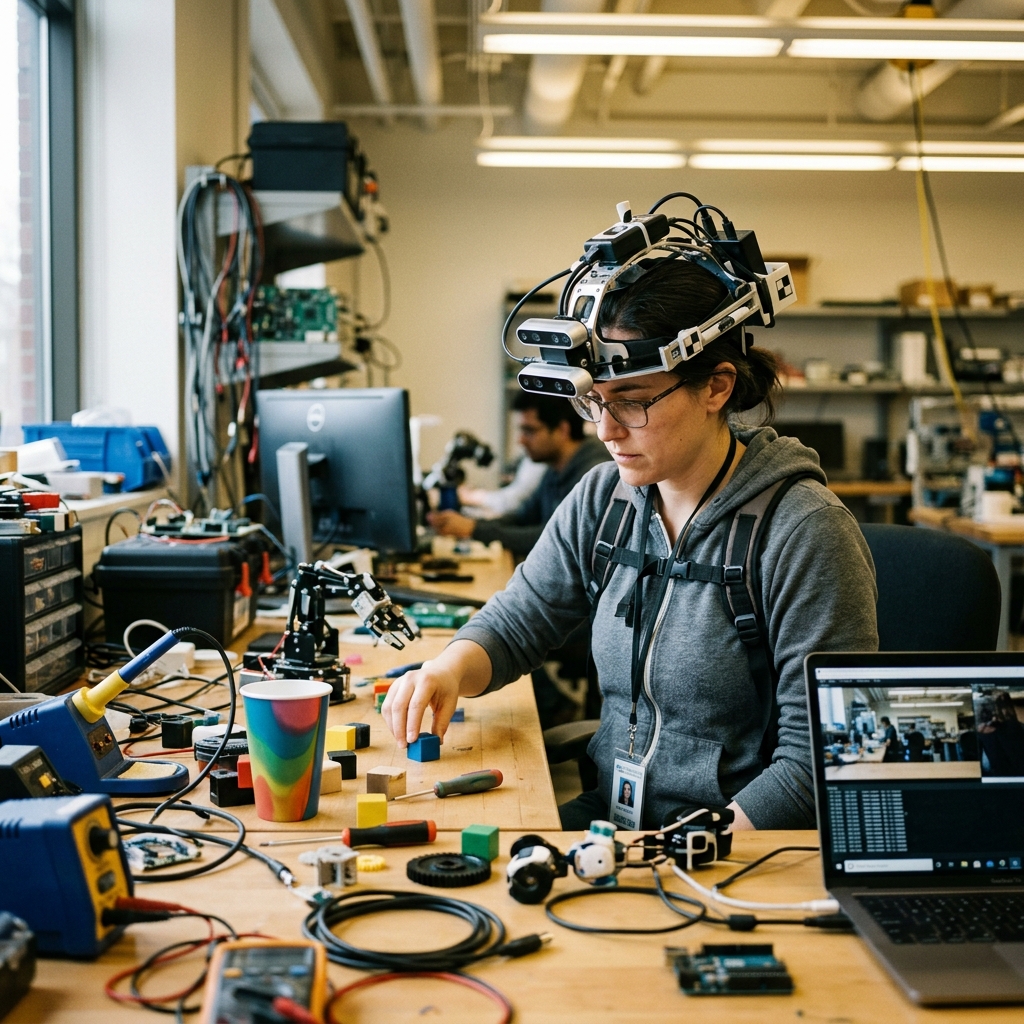
At its core, egocentric data refers to information captured from a first-person perspective, typically via wearable cameras mounted on a person's head, chest, or smart glasses. Unlike exocentric (third-person) data, which observes an agent from a distance, egocentric data records the environment from the point of view of the acting agent.
The Power of First-Person Video
First-person video is uniquely positioned to capture the intricacies of human behavior. When a human prepares a meal, assembles a piece of furniture, or repairs an appliance, an egocentric camera naturally focuses on the most critical elements of the task: the hands and the objects being manipulated.
This perspective inherently filters out extraneous background information, naturally centering the visual field on the task at hand. For physical AI models, this means the training data has an implicit attention mechanism. The camera angle dictates that whatever is in the center of the frame is likely the most important aspect of the ongoing interaction.
The Core Components of Egocentric Data
To understand why first-person human video is so valuable for training robots, we must break down the specific types of information it contains.
Hand-Object Interaction
The crux of most robotic manipulation tasks is the interaction between an end-effector (a gripper or robotic hand) and an object. Egocentric video provides millions of hours of natural hand-object interaction. It captures the subtle ways humans pre-shape their hands before grasping an object, how they adjust their grip based on weight distribution, and the specific contact points required for different functional uses (e.g., holding a hammer by the handle versus the head).
Datasets like Ego4D and Epic-Kitchens have pioneered the collection of this data, providing researchers with vast libraries of humans interacting with everyday objects. By training on this data, robotic vision systems can learn to recognize object affordances—the properties of an object that show how it can be used or interacted with.
Human Demonstrations at Scale
Traditional robot training relies heavily on teleoperation or kinesthetic teaching, where a human manually guides a robot through a task. While highly accurate, this method of collecting human demonstrations is notoriously slow, expensive, and difficult to scale.
Egocentric video acts as a passive, highly scalable alternative for collecting human demonstrations. Humans can go about their daily lives wearing smart glasses, inadvertently generating thousands of hours of demonstration data. While this data lacks the precise joint torques and motor commands of direct teleoperation, it contains the high-level intent, sequencing, and visual state-changes necessary to complete complex tasks.
Temporal Action Information
Robotics is not a static problem; it is inherently temporal. Actions unfold over time, and a robot must understand the sequence of events that leads to a successful outcome.
Egocentric video is rich in temporal action information. It captures the full lifecycle of an action:
- Pre-condition: The state of the environment before the action begins.
- Execution: The kinematics of the hands moving and manipulating objects.
- Post-condition: The final state of the environment after the action is completed.
By processing continuous first-person video streams, AI models can learn to predict the next state of an environment, understand causal relationships, and develop long-horizon planning capabilities.
The Benefits of Egocentric Data for Robot Learning
Integrating egocentric human data into robot learning pipelines offers several transformative advantages for physical AI engineering.
Understanding Object Interaction and Affordances
One of the most significant hurdles in robotic manipulation is generalization. A robot trained to pick up a red mug might fail when presented with a blue glass. Egocentric data helps overcome this by teaching robots about fundamental object interactions rather than rote memorization of specific items.
When models are trained on first-person video, they learn where humans tend to touch objects and how those objects react to force. This enables the prediction of interaction hotspots and object affordances. For instance, an AI can infer that handles are for pulling and buttons are for pressing, simply by observing thousands of instances of humans doing exactly that.
Scaling Up Training Data Beyond the Lab
Robot data is notoriously difficult to collect. Lab environments are constrained, and edge-cases are hard to engineer. Egocentric data allows researchers to tap into the "in-the-wild" diversity of human environments.
Because humans can wear cameras anywhere, egocentric datasets encompass a vast array of lighting conditions, background clutters, object variations, and unexpected scenarios that would take years to replicate in a robotics lab. This diversity is crucial for training foundation models for robotics that can operate in unpredictable, unstructured human environments.
Visual Representation Learning
Before a robot can act, it must perceive. Pre-training vision models on egocentric data has proven highly effective for downstream robotic tasks. Models trained using self-supervised learning techniques (like masked autoencoders or contrastive learning) on massive egocentric datasets develop robust visual representations.
These representations encode a deep understanding of physical physics, object permanence, and 3D spatial geometry, which can then be fine-tuned for specific robotic control tasks with much less robot-specific data.
How Egocentric Data Complements Robot-Collected Data
It is crucial to understand that egocentric video does not replace traditional robot data (like teleoperation logs or simulation data); rather, it acts as a powerful complement.
Bridging the Domain Gap
The primary challenge of using human video for robot learning is the domain gap. Humans have multi-fingered, highly dexterous hands, while most robots have parallel jaw grippers or simplified robotic hands. Furthermore, human video lacks the proprioceptive data (joint angles, torque sensing) and specific action commands required for low-level robot control.
To solve this, researchers use a hybrid approach. Egocentric data is used to train the high-level cognitive aspects of the AI—such as visual perception, semantic understanding, task sequencing, and intent recognition. The model learns what to do and how the environment should change.
Robot-collected data (teleoperation) is then used to bridge the gap to low-level control. By fine-tuning the pre-trained model on a smaller dataset of actual robot executions, the AI learns how to map its high-level understanding onto its specific physical embodiment.
From Human Kinematics to Robot Control
Recent advancements in computer vision, such as 3D hand tracking and pose estimation, have made it easier to extract kinematic data from egocentric video. By tracking the human hand in 3D space, researchers can retarget human motions onto robotic manipulators.
This means that while the raw video lacks joint torques, the extracted 3D trajectories can serve as a dense reward signal or a guiding heuristic for reinforcement learning algorithms training in simulation or the real world.
Limitations and Challenges
Despite its immense potential, leveraging egocentric data in robotics comes with substantial challenges that the AI community must address.
Privacy and Consent
The most pressing non-technical challenge is privacy. Wearable cameras capture not only the wearer's actions but also bystanders, private conversations, sensitive documents, and intimate environments (like homes or hospitals).
Building large-scale egocentric datasets requires rigorous anonymization protocols. Faces must be blurred, audio often must be scrubbed, and explicit consent must be obtained from participants. As companies look to harvest "in-the-wild" data from consumer smart glasses to train robotics models, navigating the ethical and legal frameworks surrounding data privacy will be paramount.
The Morphological Translation Problem
As mentioned earlier, the physical difference between humans and robots is a significant hurdle. A human hand has 27 degrees of freedom, tactile skin, and complex musculature. Translating an action performed by a human hand (e.g., smoothly rotating a pen) to a parallel jaw gripper is not a 1-to-1 mapping.
Models must learn to abstract the intent of the human action rather than blindly copying the kinematics. If a human uses five fingers to unscrew a jar lid, a robot with a two-finger gripper must invent a completely different physical strategy to achieve the same state change.
Annotation Requirements
While the collection of egocentric video is relatively cheap and scalable, making that data useful often requires expensive human annotation. To train supervised models, videos must be annotated with action labels, object bounding boxes, hand segmentation masks, and temporal boundaries.
While self-supervised learning is reducing the reliance on manual labeling, heavily annotated datasets are still required for benchmarking and fine-tuning. Generating accurate 3D annotations from 2D video, especially when objects are severely occluded by hands, remains an active area of computer vision research.
Hardware Limitations and Motion Blur
Egocentric video is inherently unstable. Head movements introduce severe motion blur, sudden changes in lighting, and rapid field-of-view shifts. Robotics models trained on this data must be highly robust to these artifacts. Additionally, the camera angle is fixed to the head, meaning the hands or objects may frequently move out of frame, interrupting the temporal flow of the action.
The Future of First-Person Vision in Robotics
The trajectory of physical AI is inextricably linked to our ability to leverage massive amounts of video data. As foundation models for robotics become more sophisticated, their appetite for diverse, unstructured data will only grow.
Egocentric data provides a window into the physical interactions that define the human experience. By continuously refining our methods for extracting intent, tracking 3D kinematics, and overcoming the morphological domain gap, first-person human video will soon become the bedrock upon which general-purpose robots are trained.
Ultimately, teaching a robot to navigate and manipulate our world requires showing it the world through our own eyes.