How Humanoid Robots Learn: The Role of Human and Robot Data
The transition from rigid industrial automation to dynamic, general-purpose humanoid robots represents one of the most significant engineering challenges of our time. Traditional robots excel in highly structured environments, executing meticulously pre-programmed scripts with sub-millimeter precision. However, when placed in a typical human environment—a chaotic, unstructured world filled with clutter, moving people, and infinite variations of everyday objects—these traditional systems fail spectacularly. To operate in our world, humanoids must learn to fold laundry, open doors, grasp fragile objects, and respond to fluid natural language commands, all while dynamically balancing on two legs.
Achieving this level of physical intelligence is fundamentally a data problem. Instead of relying on manual hard-coding, modern physical AI engineers are turning to a powerful paradigm: imitation learning fueled by massive datasets of human and robot behavior. By observing how humans perform tasks and intelligently mapping those observations to robotic controls, humanoids are learning to interact with the physical world with unprecedented dexterity and adaptability.
This comprehensive guide explores the intricate mechanics of how humanoid robots learn, the critical role of human and robot data, and how cutting-edge initiatives—such as Figure's ambitious Project Go-Big and their Helix model—are paving the way for the next generation of physical AI.
The Foundations of Imitation Learning
At the heart of modern robotic learning is the concept of imitation learning. This is a technique where a robot learns to perform a task by observing a human demonstrator, much like a human apprentice learns from a master craftsman. Rather than manually calculating and programming individual joint angles, inverse kinematics, and actuator torques, engineers provide the robot with large datasets showing how a task is done successfully. The AI models then learn the underlying patterns, generalizing the behavior so the robot can reproduce it even in novel situations.
Behavior Cloning: The Direct Approach
Behavior cloning is the most direct and intuitive form of imitation learning. It treats the complex challenge of robotic control as a supervised machine learning problem. The robot is fed a dataset consisting of pairs of inputs and outputs: observations (what the human or robot sees and feels) and actions (what the human or robot subsequently does).
During the training phase, a deep neural network learns to map a given observation directly to the correct action. If the robot's camera registers a red cup on a kitchen counter, the network predicts the precise sequence of joint movements required to reach for it, based on thousands of examples of humans doing exactly that. While conceptually straightforward, behavior cloning is highly effective when provided with high-quality, diverse data.
However, behavior cloning can suffer from a phenomenon known as "covariate shift" or compounding errors. Because the model's predictions are never perfect, a small error in the robot's initial movement can place it into a physical state it has never encountered in the training data. The model then makes a larger error in its next prediction, leading to a cascading failure. To mitigate covariate shift, modern approaches utilize highly expressive, high-capacity models and massive, heavily augmented datasets to ensure the robot has learned how to recover from mistakes and edge cases.
The Shift to Vision-Language-Action (VLA) Models
The field of humanoid robotics is rapidly adopting Vision-Language-Action (VLA) models, representing a massive leap forward in physical AI capabilities. These models are effectively the physical AI equivalent of Large Language Models (LLMs). While an LLM takes text as input and predicts the next word in a sequence, a VLA takes an image (vision) and a natural language command (language) as input, and predicts the next physical movement (action).
Training these state-of-the-art VLA models requires datasets that are rich in three specific dimensions:
- Visual Context: High-resolution streams of what the scene looks like from multiple angles, capturing depth, color, and object relationships.
- Linguistic Context: Natural language annotations detailing what task is being performed, broken down into high-level goals ("clean the kitchen") and low-level steps ("pick up the sponge").
- Action Context: The precise, high-frequency movements required to execute the task safely and efficiently.
By unifying perception, semantic language understanding, and fine motor control into a single, cohesive neural network, VLAs allow humanoids to perform complex, long-horizon tasks. They can respond to natural language commands seamlessly, without requiring task-specific programming for every new scenario they encounter.
Human Demonstrations: The Gold Standard of Data
To train these massive, data-hungry VLA models, robotics engineers require a staggering amount of data—specifically, data that demonstrates how to solve physical problems in the real world. Human demonstrations remain the gold standard in physical AI because humans implicitly possess the common sense, intuitive physics knowledge, and dexterous capabilities required to navigate our environments.
Researchers rely on two primary methods for collecting high-fidelity human demonstrations: teleoperation and egocentric human video.
Teleoperation: Puppeteering the Future
Teleoperation involves a skilled human operator remotely controlling a robot to perform a specific task. This is often achieved using sophisticated interfaces. The operator might wear a virtual reality (VR) headset for immersive visual feedback and use haptic hand-tracking controllers, or operate a specialized physical rig—sometimes referred to as a "waldo" or exoskeleton—that precisely captures their arm, hand, and finger movements.
As the human operator completes the task, the system records two crucial, synchronized streams of data:
- Robot Sensor Data: The live video feed from the robot's head and wrist cameras, depth maps from LiDAR or stereo vision, and proprioceptive sensors which track the exact position, velocity, and effort of the robot's joints.
- Robot Trajectories: The exact, high-frequency sequence of joint angles and torques executed by the robot to complete the task in the physical world.
Teleoperation provides exceptionally high-quality data. Because the human is operating the robot directly, there is a perfect one-to-one mapping between the recorded actions and the robot's physical capabilities. There is no ambiguity in the data. However, teleoperation is inherently slow, expensive, and difficult to scale. It requires highly trained operators, low-latency network connections, and dedicated time on expensive humanoid hardware. To train highly capable generalized VLAs, engineers need millions of hours of data, making an exclusive reliance on teleoperation a major bottleneck.
Egocentric Human Video: Seeing the World Through Human Eyes
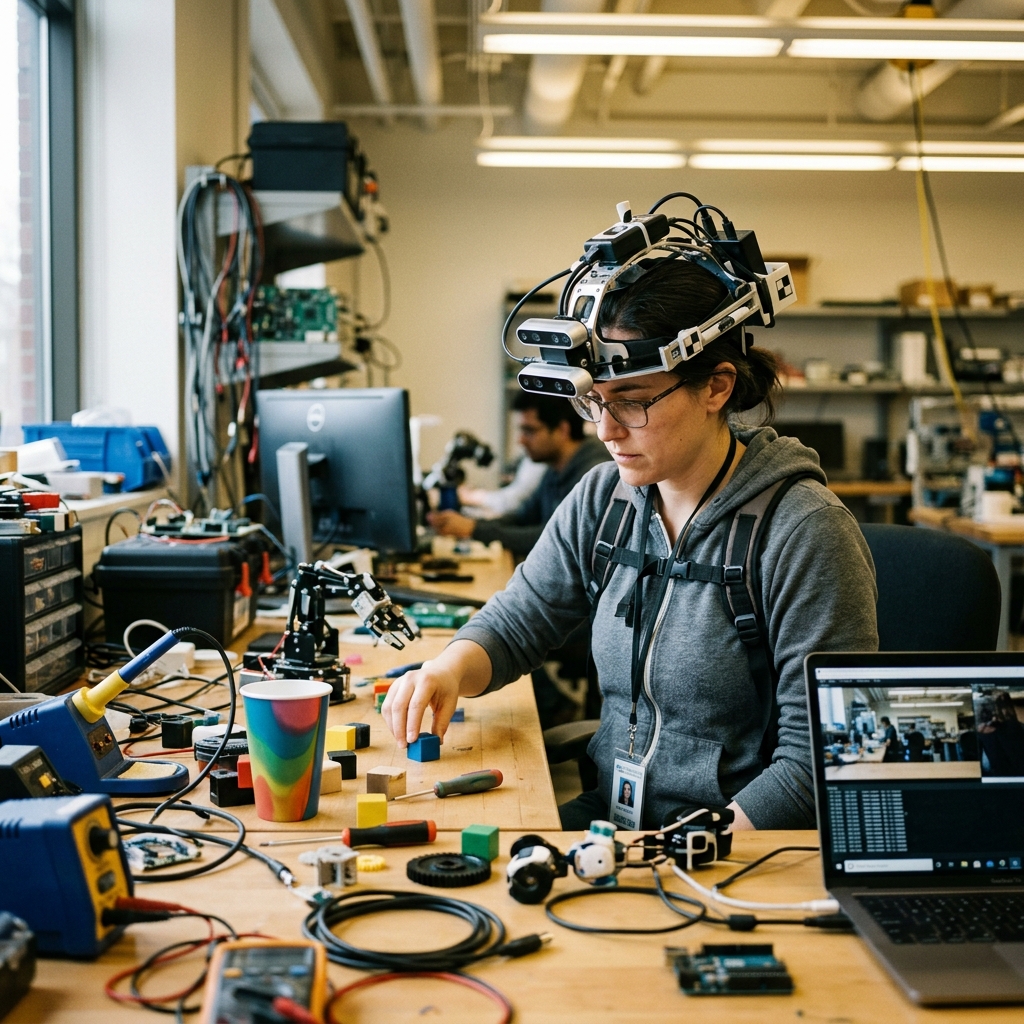
To overcome the scaling limitations of teleoperation, researchers are increasingly turning to egocentric (first-person) human video. In this highly scalable approach, human workers wear specialized smart glasses equipped with wide-angle cameras and inertial sensors while going about their daily lives—cooking meals, cleaning houses, organizing warehouses, or assembling products on a factory floor.
Egocentric video provides a massive, scalable source of naturalistic training data. It captures the rich visual stream of exactly what a human sees while manipulating objects, providing an abundance of examples of common sense reasoning, physics, and object permanence. Because humanoid robots are explicitly designed to mimic the human form factor, they are uniquely positioned to learn effectively from this human-centric visual data.
The primary challenge with egocentric video, however, is the lack of explicit action data. The video clearly shows the human hand moving and grasping an object, but it does not provide the exact joint angles and actuator torques required for a robotic arm to replicate that specific movement. This limitation necessitates advanced algorithmic solutions to translate human kinematics into robotic control signals.
Bridging the Gap: Transferring Human Behavior to Robots
The process of translating human demonstrations—especially from egocentric video—into actionable robotic data involves overcoming a significant engineering hurdle known as the "embodiment gap."
Overcoming the Embodiment Gap
The embodiment gap refers to the fundamental physical differences between a human being and a robot. Even a highly advanced, biomimetic humanoid has different kinematics, mass distribution, joint limits, degrees of freedom, and sensor placements than a human. For example, a human hand boasts 27 degrees of freedom and highly sensitive skin, while a typical robotic hand might have only 10 to 15 degrees of freedom and sparse tactile sensors.
When a robot attempts to learn from egocentric human video, it must dynamically translate the human's actions into its own physical constraints. This complex translation is often achieved through a pipeline of computer vision and robotics algorithms:
- Pose Estimation: Advanced computer vision algorithms track the human's hand, arm, and body movements in the video frame by frame, estimating their precise 3D position and orientation in space.
- Retargeting: Mathematical models map the estimated human pose to the corresponding robotic joints. This process involves finding the closest possible approximation of the human movement that the robot can physically execute without violating its joint limits or self-colliding.
- Inverse Kinematics: Complex algorithms calculate the specific joint angles and angular velocities required to position the robotic end-effector (the hand) in the desired 3D location to interact with the target object.
The Role of Robot Sensor Data and Trajectories
Once the embodiment gap is bridged and the human intent is mapped to the robot, the learning process relies heavily on the robot's own internal sensor data streams. A modern humanoid robot generates an immense amount of multimodal data every single second:
- Vision: High-resolution RGB cameras and depth sensors continuously map the 3D environment in real-time.
- Proprioception: High-resolution encoders in every single joint provide exact feedback on position, velocity, and applied torque, ensuring the robot knows exactly where its body is in space.
- Tactile Sensors: Advanced humanoids feature sophisticated tactile sensors embedded in their fingertips. These sensors provide critical feedback on grip strength, object slippage, and surface texture—information that is absolutely crucial for dexterous manipulation of fragile or deformable objects.
During the training phase, the VLA model learns to deeply correlate these distinct sensor streams. It learns that visually identifying a fragile object (vision) requires a lighter, more precise grasp (tactile feedback) and specific, controlled joint configurations (proprioception). The final output of the VLA model is a continuous, high-frequency stream of robot trajectories—precise electrical commands sent directly to the actuators to physically move the robot in the real world.
The Importance of Diverse Demonstrations
In the realm of physical AI, the robustness and reliability of the model are directly proportional to the scale and diversity of the training data. If a robot is only trained to pick up red plastic cups on a white table under bright fluorescent lighting, it will almost certainly fail if asked to pick up a blue ceramic mug on a wooden table in dim natural sunlight.
To build truly robust, general-purpose humanoids that can operate reliably in homes and businesses, engineers must expose the VLA models to an incredible variety of edge cases and situations. Diverse demonstrations matter for several critical reasons:
- Lighting and Visual Variance: Robots must operate seamlessly in bright direct sunlight, dim rooms, and shifting, complex shadows. Data must be collected across all conceivable lighting conditions to train robust computer vision systems that do not rely on perfect illumination.
- Object Diversity: The concept of a "cup" encompasses a heavy ceramic mug, a flimsy plastic disposable cup, or a delicate, stemmed wine glass. The robot must physically encounter and manipulate thousands of variations to learn the generalized concept of a "cup" and how to safely handle vastly different materials and geometries.
- Background Clutter and Occlusion: Real-world environments are inherently messy and chaotic. A robot must learn to identify and grasp a target object even when it is partially obscured or surrounded by a background of irrelevant, distracting items.
- Failure Recovery and Edge Cases: Counterintuitively, the most valuable data often comes from mistakes. If a human operator slightly fumbles an object during teleoperation and immediately adjusts their grip to recover it, the robot learns how to recover from a failure state. This makes the resulting system far more resilient and capable of handling unexpected real-world physics.
- Environmental Variability: A robot trained exclusively in a pristine, controlled laboratory setting will struggle in a crowded warehouse or a cluttered living room. Demonstrations must be systematically gathered in the exact, unstructured environments where the robot is ultimately expected to operate.
Case Study: Figure's Helix and Project Go-Big
To understand how these abstract concepts are applied at the cutting edge of the robotics industry, we can closely examine Figure AI, one of the leading developers of autonomous humanoid robots. Figure's approach to achieving general-purpose physical intelligence centers around a powerful VLA model called Helix and an unprecedented data collection initiative known as Project Go-Big.
Helix: The VLA Brain Powering Figure
Helix is Figure's proprietary Vision-Language-Action (VLA) model. It represents a state-of-the-art unified architecture where visual perception, natural language understanding, and high-frequency motor control are processed entirely within a single, end-to-end neural network.
By tightly integrating these functions, Helix enables Figure's humanoid platforms—such as the Figure 02 and Figure 03—to perform highly complex, long-horizon tasks autonomously. A human user can issue a high-level natural language command, such as "clean up the kitchen." The Helix model will visually process the scene, identify the relevant objects (sponges, dishes, trash), break the overarching command down into sequential logical steps, and generate the necessary robot trajectories to execute the task flawlessly.
Crucially, Helix is designed to allow for zero-shot transfer. This means the robot can operate in entirely novel environments and manipulate objects it hasn't explicitly been trained on, relying instead on its generalized, foundational understanding of the physical world learned from massive datasets.
Project Go-Big: Building the "YouTube for Robot Behavior"
Figure recognizes that the primary bottleneck holding back physical AI is not necessarily algorithmic architecture, but rather a profound lack of scale in robotic data. While Large Language Models can easily scrape the entire internet for trillions of tokens of text, there is no equivalent, readily available corpus of physical robot behavior.
To solve this critical data shortage, Figure launched Project Go-Big. This is an aggressive, large-scale initiative designed to build the world's largest and most diverse humanoid pretraining dataset. The ultimate goal is to create what amounts to a "YouTube for robot behavior"—a massive, searchable repository of human demonstrations that the Helix VLA model can learn from.
Project Go-Big utilizes multiple innovative strategies to gather this high-quality data at an unprecedented scale:
- Massive Egocentric Human Video: Figure heavily leverages the collection of first-person video. They have humans record themselves performing thousands of daily, mundane tasks to provide the models with a foundational understanding of human-object physical interactions.
- The Index Gig Economy Platform: To rapidly accelerate specialized data collection, Figure launched Index, an innovative gig economy platform tailored for physical AI. Through Index, human workers can be hired to perform specific, targeted tasks while wearing specialized sensor rigs and camera glasses, generating high-quality, structured training data for the robots in a scalable manner.
- The Brookfield Partnership: In a strategic move to access diverse real-world environments, Figure partnered with Brookfield Asset Management, a major global asset manager. This partnership grants Figure unprecedented access to a massive portfolio of residential buildings, commercial offices, and logistics spaces. This allows Figure to collect real-world data across a diverse range of truly unstructured environments, ensuring the Helix model is trained on the exact spaces where their humanoid robots will eventually be deployed for commercial use.
By combining the powerful, scalable VLA architecture of Helix with the massive, incredibly diverse dataset generated by Project Go-Big, Figure is working aggressively to move humanoid robots out of controlled research laboratories and into our daily lives and workplaces.
The Future of Humanoid Learning and Physical AI
The convergence of massive datasets, advanced VLA models, and increasingly capable, reliable robotic hardware is accelerating the development of physical AI at a breakneck pace. As data collection initiatives like Project Go-Big scale up and algorithms become even more efficient at bridging the embodiment gap, we will inevitably see humanoid robots capable of increasingly complex, generalized, and useful tasks.
The path to true, general-purpose robotic autonomy is paved with data—millions of hours of human demonstrations, teleoperated trajectories, and egocentric video. By learning directly from us, observing how we interact with our environment, humanoid robots are finally learning how to navigate and master the physical world.
Related Robotics Data Insights
To continue exploring the critical role of data in the development of physical AI and humanoid robotics, check out these related resources: