The development of artificial intelligence has historically been driven by the availability of massive, diverse datasets. Large Language Models (LLMs) ingest petabytes of text scraped from the internet, while foundational computer vision models are trained on billions of annotated images. However, as AI transitions from the digital realm into the physical world—a transition often referred to as the era of Physical AI—engineers and researchers face a profound and stubborn data bottleneck.
Unlike text or images, robotics data is deeply intertwined with physical laws, specific hardware embodiments, and continuous interaction with complex environments. You cannot simply scrape the internet for a dataset of a custom, six-degree-of-freedom robotic arm assembling a novel automotive transmission system. This fundamental scarcity has sparked a massive, ongoing debate within the robotics community: should teams invest heavily in gathering pristine, real-world data, or should they rely on the infinite scalability of synthetic data generated in simulation?
The reality of modern robotics engineering is that neither approach is universally superior. The most successful physical AI systems leverage the distinct strengths of both. In this comprehensive guide, we will explore the nuances of real-world robotics data, the rise of synthetic data and digital twins, the formidable challenge of the domain gap, and how hybrid data strategies are shaping the future of autonomous systems.
The Data Bottleneck in Physical AI
To understand the debate between real and synthetic data, one must first recognize the unique, multi-dimensional challenges of training physical AI. When a robot interacts with the physical world, it processes streams of high-dimensional, multi-modal sensor data—RGB-D cameras, LiDAR, joint encoders, tactile sensors, and Inertial Measurement Units (IMUs)—and must map these inputs to continuous, high-frequency motor commands.
Learning these complex mappings requires data that accurately captures the subtleties of real-world physics: non-linear friction, mass distribution, contact forces, and complex lighting conditions. Furthermore, robotics tasks are inherently sequential and temporally dependent. A single micro-mistake early in a task can compound over time, leading to catastrophic failure states that the robot has never encountered during its training phase. This phenomenon, known as compounding errors or covariate shift, means that robotics models need a massive diversity of data. They must learn not just the optimal path (the "happy path"), but also how to recover from near-failures, disturbances, and extreme edge cases.
Acquiring this volume and diversity of high-quality data is the primary bottleneck in scaling physical AI today. It is the core reason why we have highly articulate conversational AI, yet struggle to build a robot that can reliably fold laundry in a novel environment.
The Case for Real-World Robotics Data
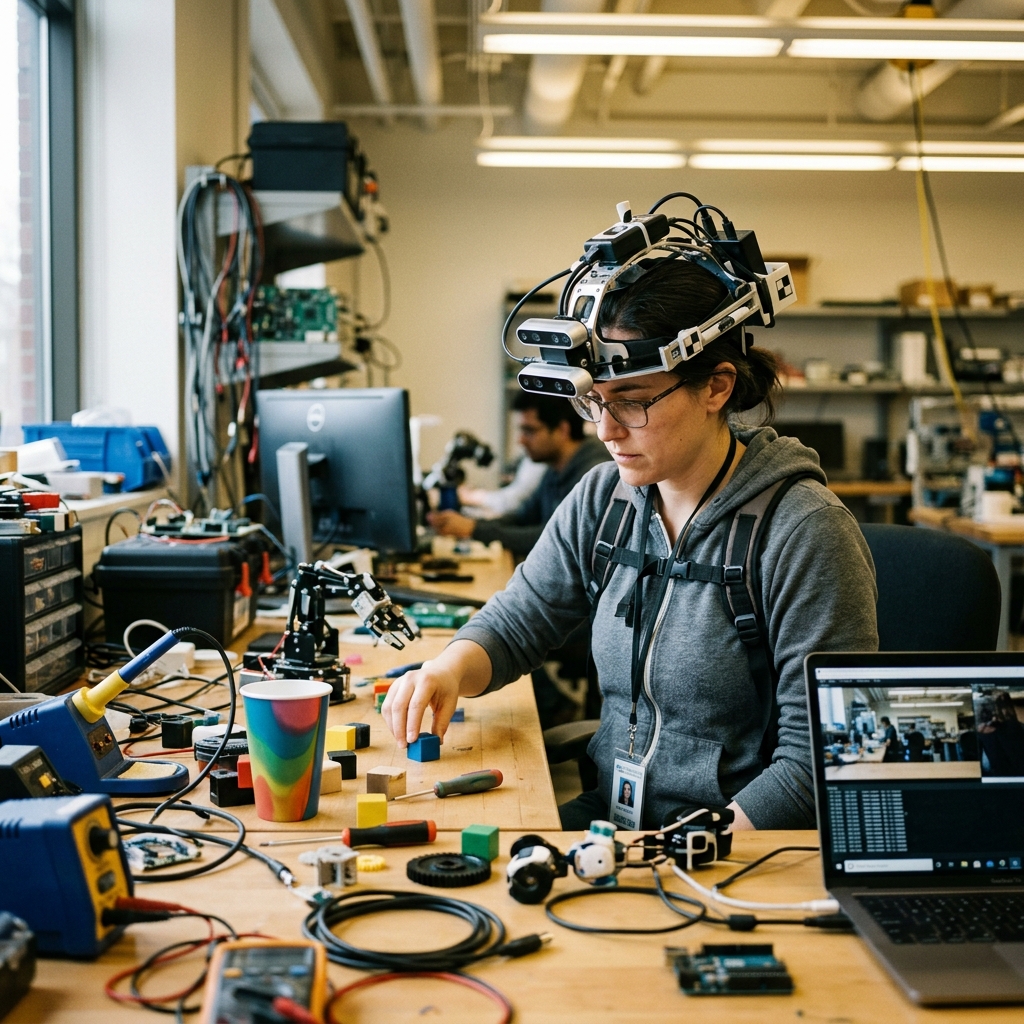
Real-world data is collected directly from the physical hardware operating in its actual deployment environment. This data is typically gathered through various hands-on methods: teleoperation (where a human pilot controls the robot remotely to demonstrate a task, often using VR interfaces), kinesthetic teaching (physically moving the robot's limbs to guide it through a trajectory), or autonomous exploration (where a robot acts randomly or heuristically to gather data).
Advantages of Real-World Data
The most significant and undeniable advantage of real-world data is its absolute fidelity to the ground truth of the universe. There is no approximation of physics; the data inherently captures the exact friction of the workspace, the specific noise profile of the sensors, and the true dynamics of the robot's actuators.
- Ground Truth Physics and Mechanics: Complex physical interactions are notoriously difficult to simulate. Tasks involving deformable objects (e.g., folding a shirt, routing a flexible cable), fluid dynamics (e.g., pouring water or mixing chemicals), and non-linear friction (e.g., sliding a heavy box across a varied floor) are captured natively and perfectly in real-world data.
- Zero Domain Gap: Models trained entirely on real-world data do not suffer from the infamous "sim-to-real" gap. Because the data distribution encountered during the training phase perfectly matches the distribution encountered during deployment, the AI does not have to bridge a reality divide.
- Human-Level Dexterity and Intuition: Teleoperated demonstrations inherently capture the subtle, intuitive corrections a human operator makes. These micro-adjustments and force-feedback responses are invaluable for teaching robots fine manipulation tasks, such as inserting a tight-fitting peg into a hole, handling delicate materials, or interacting safely with humans.
The Challenges of Real-World Collection
Despite its pristine quality and high fidelity, relying exclusively on real-world data presents severe operational, financial, and logistical hurdles.
- Prohibitive Cost and Scale: Operating a fleet of physical robots requires massive capital expenditure, ongoing hardware maintenance, battery management, and human supervision. Collecting millions of episodes—the scale often required for modern deep reinforcement learning or foundational imitation learning—is financially and logistically unfeasible for all but the most well-funded organizations.
- Safety Constraints: Learning inherently entails failure. In software, an AI failing means a crashed program or a bad output. In robotics, an AI failing during training can result in shattered hardware, damaged facilities, or severe injury to human operators. This makes trial-and-error learning (like unconstrained reinforcement learning) extremely dangerous to execute directly in the real world.
- Data Diversity and Rare Events (The Long Tail): Collecting data for long-tail edge cases is notoriously difficult. How do you safely collect data on a delivery robot avoiding a high-speed collision with an unpredictable pedestrian? How do you train an autonomous vehicle to recover from a blown tire on black ice? Relying solely on the real world means that rare but critical, safety-compromising events are heavily underrepresented in the dataset.
The Rise of Synthetic Data and Simulation
To circumvent the severe cost, scale, and safety limitations of physical data collection, the robotics industry has aggressively pivoted toward simulation. Synthetic data is generated by modeling the robot, its sensors, and its environment in a high-fidelity physics engine, rendering the sensor outputs computationally.
The evolution of simulation platforms—spearheaded by advanced technologies like NVIDIA's Omniverse and Isaac Sim—has transformed synthetic data from a rudimentary visualization tool into a foundational cornerstone of Physical AI development. By leveraging massive GPU acceleration, these platforms simulate rigid body dynamics, complex contacts, and photorealistic ray-traced rendering at speeds thousands of times faster than real-time. Initiatives like NVIDIA's Project GR00T and Isaac Lab specifically target the scaling of robot learning for complex humanoids entirely in simulation before physical deployment.
Advantages of Synthetic Data
- Infinite Scale and Low Marginal Cost: In simulation, data collection is limited only by available computing power. Millions of distinct trajectories can be simulated in parallel across a cloud server cluster in a matter of hours—a feat that would take decades or centuries to replicate in the physical world.
- Absolute Safety for Rare Events: Simulation is the perfect, consequence-free sandbox for danger. Robots can be subjected to extreme lighting changes, adversarial physical disturbances, sensor occlusions, and catastrophic hardware failures without any risk of damage. This allows the AI to learn robust recovery policies for the dangerous rare events that define the "long tail" of autonomy.
- Procedural Generation and Data Diversity: Environments can be procedurally generated on the fly. For a robotic arm tasked with bin picking, a simulation can automatically generate thousands of unique object geometries, continuously altering mass, friction, and textures. This forces the AI to learn a generalized, robust policy rather than memorizing a specific, static setup.
- Perfect, Cost-Free Labels: In synthetic environments, the exact pose, velocity, semantic segmentation, and bounding box of every object are known perfectly by the engine. This provides free, pixel-perfect ground truth annotations for training computer vision components, completely eliminating the need for expensive, slow, and error-prone human labeling.
The Limitations of Simulation
The Achilles' heel of synthetic data is that a simulation, no matter how computationally advanced, is ultimately a mathematical approximation of reality.
- The Domain Gap (Sim-to-Real Gap): The discrepancy between the simulated world and the real world is known as the domain gap. This gap manifests in two primary areas: the visual gap (differences in rendering pipelines, lighting nuances, and idealized sensor noise) and the dynamics gap (differences in friction models, mass distribution, actuator latency, and contact physics).
- Unmodeled Physics and Complexity: Certain phenomena remain computationally prohibitive or theoretically difficult to simulate accurately in real-time. Complex soft-body deformations, aerodynamics, granular materials (like sand or dirt), and chaotic fluid dynamics are notorious areas where simulators often fall critically short of reality.
- The Illusion of Competence: A robotics model that performs with 100% success in a pristine simulation may completely fail in the real world due to minor, unmodeled discrepancies. A slightly different camera exposure, a worn-out joint on the physical robot, or unexpected ambient lighting can cause catastrophic policy failure.
Bridging the Divide: Sim-to-Real Transfer
The viability and success of synthetic data hinge entirely on the ability to transfer learned policies from the simulation to the physical hardware—a process known as sim-to-real transfer. Because the domain gap is an inevitable reality of simulation, researchers have developed sophisticated techniques to ensure models don't overfit to the simulated environment.
Domain Randomization
Rather than attempting the nearly impossible task of building a perfectly accurate simulation, domain randomization takes the opposite approach: it deliberately introduces massive, structured variability into the simulated environment.
During the training phase, parameters such as object mass, friction coefficients, camera angles, lighting intensity, and even the visual textures of the background are randomized across a remarkably wide distribution. The goal is to make the simulation so varied and chaotic that the neural network learns to ignore the specific visual and physical details of the simulation, forcing it to focus only on the fundamental physics and geometries required to complete the task. If the randomization distribution is broad enough, the real world simply appears to the model as just one more variation of the simulation it has already mastered.
Domain Adaptation
Domain adaptation involves training a model to translate simulated data into realistic-looking data, or vice versa, bridging the visual or dynamic gap. For example, Generative Adversarial Networks (GANs) can be used to take rendered images from a simulator and apply "style transfer" to make them look like noisy, real-world camera feeds. This allows the primary perception network to train on images that closely mimic reality while still benefiting from the automated labeling of the simulator.
Digital Twins
For highly specific, constrained deployments—such as a fixed robotic welding cell in an automotive manufacturing plant—engineers utilize Digital Twins. A digital twin is a high-fidelity, meticulously calibrated virtual replica of a specific physical environment. Using exact CAD models, laser scans, and empirical measurements, the physics engine is painstakingly tuned to match the real-world friction and actuator dynamics as closely as mathematically possible. NVIDIA's push into industrial digital twins exemplifies this approach, allowing massive industrial facilities to simulate and validate complex robotic workflows with near-perfect accuracy before a single piece of hardware is bolted to the factory floor.
Hybrid Data Strategies: The Best of Both Worlds
In modern, state-of-the-art Physical AI development, it is rarely a binary, zero-sum choice between real and synthetic data. Recognizing that simulation provides unparalleled scale, safety, and diversity, while real-world data provides ground-truth physics, nuance, and final validation, leading robotics teams deploy sophisticated hybrid data pipelines.
Pre-training in Sim, Fine-tuning in Real
This strategy is loosely analogous to the pre-training and RLHF (Reinforcement Learning from Human Feedback) paradigm used to train highly capable Large Language Models.
- Simulated Foundation Pre-training: The robot model undergoes massive-scale reinforcement learning or imitation learning in simulation. It learns the fundamental physics of the world, how to coordinate its joints, how to navigate without colliding, and how to execute the core concepts of a task under widely varying conditions (leveraging domain randomization).
- Real-World Fine-Tuning: The sim-trained model, which now possesses a strong foundational understanding but may struggle with specific real-world noise or unmodeled friction, is deployed to the physical hardware. It is then fine-tuned using a relatively small, highly curated dataset of real-world demonstrations or limited real-world RL.
This hybrid approach drastically reduces the amount of expensive real-world data required while effectively closing the domain gap that plagues pure sim-to-real transfer.
Residual Learning
In residual learning architectures, a foundational policy is trained in simulation to solve the bulk of the physical task. However, instead of deploying this policy directly to the hardware, a secondary, much smaller neural network is trained exclusively on real-world data to calculate "residuals"—tiny, precise corrective adjustments to the simulated policy's outputs. The final motor command sent to the robot is the sum of the simulation-trained base policy and the real-world-trained residual policy. This allows the system to bridge the dynamics gap on the fly, relying on sim for the broad strokes and real data for the fine details.
Continuous Data Engines and Fleet Learning
Advanced robotics pipelines, much like those deployed in autonomous vehicle fleets, utilize continuous data engines. The model is deployed to the physical robot, and as it operates in the real world, it actively identifies edge cases, anomalies, or failure modes (e.g., scenarios where the model's internal uncertainty spikes). These specific real-world failures are automatically captured, uploaded to a centralized cloud, and used to either fine-tune the model directly or inform the procedural generation of new, highly targeted synthetic scenarios to prevent the failure from ever happening again.
Making the Decision: What Should You Use?
The decision of how to weight your data strategy depends heavily on the specific robotics application, the available budget, and the complexity of the physical interactions involved.
Lean heavily on Real-World Data when:
- The task involves highly complex, mathematically unmodellable physics (e.g., surgical robotics, handling soft or highly deformable materials like fabrics, food preparation).
- The deployment environment is static, and the required task is highly repetitive and specific (like traditional factory automation), meaning massive generalization is not strictly required.
- The required dexterity demands human-level intuition, micro-adjustments, and tactile feedback that is poorly represented in current rigid-body simulators.
Lean heavily on Synthetic Data when:
- The task requires massive generalization across thousands of different, unpredictable environments (e.g., home assistant robots, autonomous driving, delivery drones).
- Safety is a critical, uncompromising concern, and learning must occur in a completely risk-free environment before any physical deployment (e.g., training a drone to recover from mid-air motor failures).
- You need to rapidly prototype and iterate on robot morphologies (hardware designs) and test software policies simultaneously before committing to expensive manufacturing.
For the vast majority of modern physical AI initiatives, starting in a high-fidelity simulation is the most cost-effective, scalable way to achieve baseline competence. This must be followed by a targeted, strategic campaign of real-world data collection to cross the final mile of reliability and safety.
As simulation technologies like Omniverse become increasingly computationally powerful and physically accurate, the domain gap will continue to shrink. However, the physical world is infinitely complex, inherently noisy, and beautifully chaotic. Real-world data will always remain the ultimate ground truth. The future of robotics does not lie in choosing one paradigm over the other, but in mastering the alchemy of blending infinite synthetic experience with the undeniable truth of physical reality.