The transition of robots from highly structured factory environments to unstructured, dynamic real-world settings represents the core challenge of modern physical AI. Traditional robotics relied heavily on explicit state machines, precise kinematics, and rigid programming. However, when a robot needs to fold laundry, cook a meal, or assemble arbitrary parts, defining the exact motion paths programmatically becomes intractable.
Enter Imitation Learning (IL) and Behavior Cloning (BC)—paradigms where robots learn end-to-end policies directly from human experts. The lifeblood of these paradigms is teleoperation data. By placing a human in the control loop, we can capture the implicit reasoning, dexterity, and reactive corrections necessary for complex tasks, effectively distilling human intuition into actionable neural network weights.
In this comprehensive technical guide, we will explore the architecture of robot teleoperation, the anatomy of the data collected, the engineering challenges of multi-sensor synchronization, and the standardized formats used to ingest this data into modern machine learning pipelines.
What is Robot Teleoperation?
Robot teleoperation refers to the remote control of a robotic system by a human operator. In the context of physical AI and machine learning, teleoperation is rarely the end goal; instead, it is a mechanism for demonstration collection. The operator performs a task while the system records the sensory inputs (what the robot "sees" and "feels") and the control outputs (what the robot "does").
Human-in-the-Loop Control
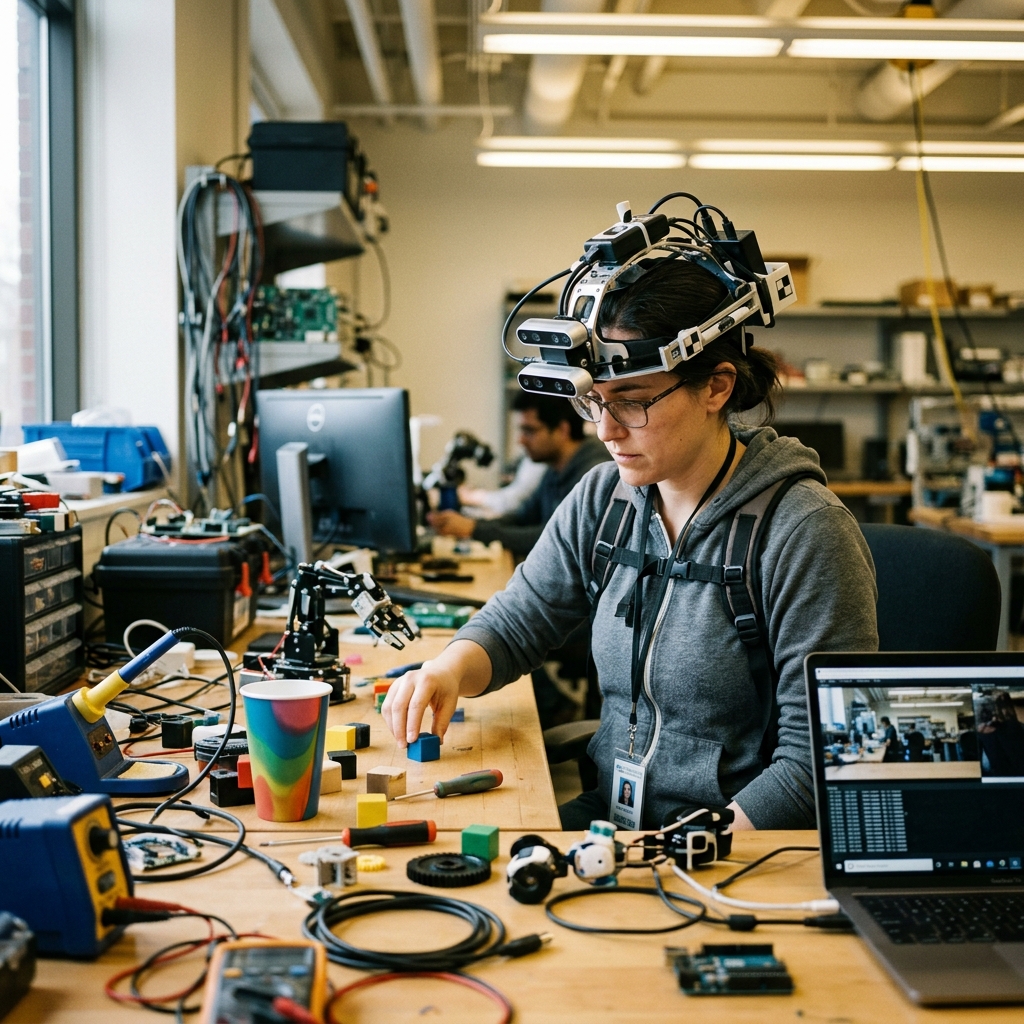
The human-in-the-loop paradigm requires an interface that maps human biomechanical intent to robot kinematic execution. Depending on the morphology of the robot and the requirements of the task, several interfaces are standard in the field:
- Leader-Follower Kinematic Arms: Systems like Stanford's ALOHA (A Low-Cost Open-Source Hardware System for Bimanual Teleoperation) utilize a smaller, physically identical or similar "leader" robot arm. The operator moves the leader arm, and the "follower" arm mimics the joint angles or end-effector poses. This provides excellent proprioceptive feedback and high-fidelity kinematic mapping.
- Virtual Reality (VR) and Spatial Tracking: Operators wear VR headsets (e.g., Meta Quest or Apple Vision Pro) and hold tracked controllers. The 6-Degree-of-Freedom (6-DoF) pose of the controllers is mapped via inverse kinematics (IK) to the robot's end-effectors. This is particularly useful for humanoid robots or tasks requiring significant spatial navigation.
- Haptic Devices: Devices like the Touch (formerly SensAble Phantom) provide force feedback, allowing the operator to "feel" contact forces during insertion or manipulation tasks, which is crucial for tasks requiring high precision and delicate handling.
- SpaceMouse and Gamepads: For simpler pick-and-place tasks, 3D mice (like the 3Dconnexion SpaceMouse) or standard gaming controllers offer a low-cost, accessible way to command Cartesian velocities.
Demonstration Collection: The Pathway to Robot Policies
A robotic policy, represented mathematically as $\pi(a_t | s_t)$, is a function that outputs an action $a_t$ given the current state observation $s_t$ at time $t$.
Demonstration collection is the process of generating a dataset $\mathcal{D} = { \tau_1, \tau_2, ..., \tau_N }$, where each trajectory $\tau_i$ is a sequence of state-action pairs: $\tau_i = { (s_1, a_1), (s_2, a_2), ..., (s_T, a_T) }$.
During teleoperation, the human operator acts as the expert policy $\pi^*$. By recording the robot's sensor data (the state $s$) and the commands issued by the operator (the action $a$), engineers create supervised learning datasets. Modern architectures, such as Diffusion Policies, Action Chunking with Transformers (ACT), and Vision-Language-Action (VLA) models, are trained directly on these state-action sequences to minimize the behavioral cloning loss—essentially teaching the neural network to mimic the human operator's actions given the same sensory inputs.
Why Teleoperation Produces High-Quality Training Data
Why go through the immense engineering effort of building teleoperation rigs instead of relying purely on Reinforcement Learning (RL) or sim-to-real transfer?
- Solving the Exploration Problem: In traditional RL, an agent must randomly explore its environment to discover rewards. In sparse reward environments (e.g., "assemble the gear into the shaft"), random exploration might take millions of years of simulated time to stumble upon the solution. Teleoperation bypasses exploration entirely by providing exact, successful trajectories directly to the goal state.
- Implicit Physics and Contact Dynamics: Simulating complex contact dynamics, friction, and deformable objects (like cloth or cables) is computationally expensive and notoriously inaccurate. Teleoperation data collected in the real world inherently captures the ground truth physics. The human operator intuitively handles friction, slip, and deformation, allowing the neural network to learn these dynamics implicitly without an explicit physics engine.
- Handling Sub-millimeter Tolerances: For tasks like threading a needle or electronic assembly, the compliance of human arms allows for micro-adjustments based on tactile feedback. Teleoperation captures these minute, reactive corrective actions that are incredibly difficult to program via classical control theory.
- No Reward Engineering: Designing a dense reward function that encourages a robot to smoothly pour a glass of water without spilling, without moving too erratically, and without colliding with the table is incredibly difficult. Teleoperation provides a template for the "correct" behavior without requiring hand-tuned mathematical reward structures.
The Anatomy of Teleoperation Data
A high-quality teleoperation dataset is highly multimodal. It must capture everything the robot needs to infer its environment and execute physical changes.
Camera Data
Vision is typically the primary modality for modern end-to-end policies.
- Egocentric (Wrist) Cameras: Mounted directly on the robot's end-effector, providing a close-up, unoccluded view of the manipulation target. Crucial for fine precision tasks.
- Third-Person (Static) Cameras: Placed in the environment or on the robot's head/torso. These provide global context, allowing the robot to understand spatial relationships and the overall scene layout.
- RGB vs. Depth (RGB-D): While RGB provides rich texture and semantic information, Depth cameras (using Time-of-Flight or structured light) provide explicit 3D geometry. Point clouds generated from depth data are often used in advanced 3D policy architectures like Perceiver or 3D Diffusion Policies.
Robot State
The internal state of the robot, known as proprioception, provides the grounding context for visual data.
- Joint Positions ($q$): The angular position of every joint in the robot arm and fingers.
- Joint Velocities ($\dot{q}$): How fast each joint is moving.
- End-Effector Pose: The calculated Cartesian position $(x, y, z)$ and orientation (quaternions or Euler angles) of the robot's tool center point.
IMU and Proprioception
For mobile manipulators and humanoids, understanding gravity, acceleration, and balance is non-negotiable.
- Inertial Measurement Units (IMUs): Provide high-frequency data on linear acceleration and angular velocity. Essential for state estimation, balancing algorithms in bipeds, and detecting sudden impacts.
- Force-Torque (F/T) Sensors: Usually mounted at the wrist, measuring forces along and moments about all three axes. This data is critical for tasks requiring contact, such as wiping a table or peg-in-hole assembly, allowing the policy to learn compliance.
Action Labels
The "ground truth" that the network is trying to predict.
- Target Joint Angles: Often preferred because they bypass the complexities and singularities of inverse kinematics during inference.
- Cartesian Velocity / Delta Pose: Commanding the robot to move its end-effector relative to its current position.
- Gripper State: Binary (open/close) or continuous (width in mm, effort applied).
Technical Challenges in Data Acquisition
Collecting data is easy; collecting good, usable data is an immense engineering challenge.
Data Synchronization
Perhaps the most insidious issue in physical AI data collection is clock synchronization. A robotic system might have a wrist camera running at 30Hz, a head camera at 60Hz, joint encoders reporting at 500Hz, and a haptic interface sending commands at 1000Hz.
If the camera frame showing an object being grasped is time-stamped even 50 milliseconds out of sync with the gripper closure command, the neural network will learn a mismatched cause-and-effect relationship.
Solutions:
- Hardware Triggering: Using a central micro-controller to send electrical pulses that simultaneously trigger the camera shutter and snapshot the joint encoders.
- Precision Time Protocol (PTP / IEEE 1588): A network protocol that synchronizes clocks across distributed systems in the sub-microsecond range, far superior to standard NTP.
- Software Interpolation: If hardware synchronization is impossible, timestamps must be rigorously recorded at the kernel level, and high-frequency data (like joint states) must be mathematically interpolated to align exactly with the camera frame timestamps during dataset generation.
Operator Variability and Suboptimal Demonstrations
Humans are not machines. An operator might pause to scratch their nose, hesitate when reaching for an object, or take three different paths to grab the exact same cup across three different episodes.
- Multimodality: If an operator goes left around an obstacle in episode 1, and right around it in episode 2, a standard Mean Squared Error (MSE) loss function will attempt to average these behaviors, causing the robot to crash straight into the obstacle. This requires advanced modeling techniques like Diffusion models or Gaussian Mixture Models to capture multiple valid modes of action.
- Covariate Shift: Human operators natively correct for tiny errors. If the robot strays from the training distribution during autonomous deployment, it won't know how to recover. Techniques like DAgger (Dataset Aggregation) involve the human operator taking over during autonomous failure to provide explicit recovery data.
Quality Control: Curation and Filtering
Raw teleoperation data is rarely ready for training. A robust data pipeline requires rigorous quality control.
- Automated Filtering: Scripts must comb through hours of data to remove episodes where the robot hit a joint limit, triggered a safety stop, or where the camera feed dropped frames.
- Idle Pruning: Operators often leave the robot stationary while setting up the next task. Training on these long periods of zero-velocity actions will result in an overly conservative policy that refuses to move. Automatic velocity thresholding is used to trim the start and end of episodes.
- Kinematic Checks: Verifying that the recorded joint angles actually match the recorded end-effector poses by running forward kinematics on the dataset. Discrepancies usually indicate dropped packets or sensor lag.
- Manual Review: Despite automation, human review (often using visualization tools like Foxglove Studio) is necessary to ensure the actual task semantics were completed successfully.
Standardizing the Pipeline: Dataset Formats
Historically, every robotics lab had a custom script parsing raw text files and JPEG images. Today, the field is coalescing around standardized formats that handle the massive scale (terabytes) of multimodal physical AI data.
ROS Bags (rosbag2)
The standard logging format for the Robot Operating System (ROS). It serializes arbitrary robotic messages into a single file. While excellent for debugging and playback, ROS bags are not optimized for random access or batching in PyTorch, requiring intermediate conversion steps.
HDF5 and Zarr
For deep learning ingestion, data must be grouped, chunked, and compressed.
- HDF5 (Hierarchical Data Format): Extremely common in offline RL and imitation learning (used heavily in the Robomimic framework). It allows grouping images, proprioception, and actions into a unified file structure.
- Zarr: Gaining rapid popularity because it is cloud-native. Zarr splits arrays into chunks that can be read concurrently from object storage (like AWS S3) by distributed GPU clusters, a requirement for training massive VLA models.
RLDS (Robotics Learning DataSets) and LeRobot
Google DeepMind introduced RLDS, an ecosystem for storing, characterizing, and manipulating episodic robotics data. It standardizes the metadata and structure, allowing researchers to combine datasets from different labs (e.g., the Open X-Embodiment dataset).
Similarly, Hugging Face’s LeRobot library is standardizing how teleoperation datasets are hosted and downloaded, providing Parquet-backed data loaders that seamlessly integrate with PyTorch, abstracting away the pain of raw file I/O.
The Future of Teleoperation Data
The bottleneck in physical AI is no longer just algorithmic; it is data-bound. The next frontier involves scaling teleoperation out of the lab. This includes building lower-cost, more intuitive teleoperation rigs, utilizing fleet learning where multiple robots gather data simultaneously, and developing semi-autonomous data collection pipelines where human operators only intervene when the robot asks for help.
As we refine how humans teach robots, the fidelity of our teleoperation data will directly dictate the intelligence and reliability of the autonomous machines deployed in our homes, factories, and hospitals.