The rapid advancement of artificial intelligence has largely been fueled by the availability of massive datasets. Large Language Models (LLMs) and generative image models thrive on internet-scale text and image data, absorbing trillions of tokens and billions of pixels to achieve unprecedented capabilities. However, when we transition from the digital realm to the physical world, the paradigm shifts dramatically. The development of physical AI—intelligent systems capable of understanding and interacting with the physical environment—faces a critical bottleneck: the lack of high-quality robotics training data.
Unlike language models that can scrape the internet for vast amounts of text, robots require data that is grounded in physical reality. They must navigate a world bound by gravity, friction, and unpredictable dynamics. As organizations like DeepMind, NVIDIA, and OpenAI push the boundaries of embodied AI, it is becoming increasingly clear that the next major leap in AI will not come simply from larger models, but from fundamentally better robot data.
In this article, we will explore why robotics data differs so significantly from digital datasets, the unique challenges of physical-world interaction, and why investing in high-quality AI robotics data is essential for the future of automation.
The Core Difference: Internet-Scale vs. Physical-World Data
To understand why robot training data is so challenging to acquire, we must first contrast it with the data that powers today's leading AI models. Text and image data are static, ubiquitous, and relatively easy to collect. A web crawler can index millions of articles in a matter of hours, providing a rich corpus for an LLM to learn the statistical relationships between words.
Robotics datasets, on the other hand, are fundamentally different. They are inherently tied to physical-world interaction.
- Embodied Context: A robot's actions are meaningless without context. When a robot reaches for an object, the success of that action depends on the exact position, orientation, weight, and material properties of the object, as well as the robot's own kinematics and the surrounding environment.
- Time and Physics: Internet data is largely static. Robotics data is dynamic, unfolding over time in a physical space governed by complex laws of physics. A small error in a robot's perception can lead to a cascading failure in its physical execution.
- Cost of Collection: You cannot scrape the physical world. Collecting robot learning data requires physical hardware, human supervision, and controlled environments. It is a slow, expensive, and labor-intensive process.
The leap from digital to physical AI requires datasets that capture the rich, multi-modal, and interactive nature of the real world. Without this, robots will remain confined to structured factory floors, unable to generalize to the messy reality of homes, hospitals, and dynamic industrial environments.
The Anatomy of Robot Training Data
High-quality robotics training data is not a single monolith. It is a complex tapestry woven from various modalities, each critical for teaching a robot how to perceive, reason, and act.
Sensor Data: The Eyes and Ears of Physical AI
A robot's understanding of the world begins with its sensors. Unlike a language model that processes clean, discrete tokens, a robot must make sense of noisy, continuous, and high-dimensional sensor data.
- Vision (RGB and Depth): Cameras provide the visual context, but depth sensors (like LiDAR or RealSense) are crucial for spatial awareness. The robot needs to know not just what an object is, but exactly where it is in 3D space.
- Proprioception: A robot must know its own body. Proprioceptive data includes the joint angles, velocities, and torques of the robot's limbs, essential for precise motor control.
- Tactile and Force Feedback: When a human picks up a fragile egg, they rely heavily on tactile feedback to apply the right amount of pressure. For robots, force-torque sensors and tactile skins provide this critical information, preventing them from crushing objects or dropping them.
The challenge lies in synchronizing and processing these disparate data streams in real-time, creating a cohesive representation of the world.
Robot Trajectories: Mapping Action to Intent
At the heart of robot learning data are robot trajectories. A trajectory is a sequence of states and actions over time. It tells the AI, "Given this sensor input, the robot took this action, which resulted in this new state."
Collecting high-quality trajectories is exceptionally difficult. If a robot is left to explore randomly (as in early reinforcement learning approaches), it will spend millions of cycles flailing before it stumbles upon a useful action. Therefore, guided trajectories are essential for efficient learning. These trajectories must be smooth, precise, and goal-oriented.
Human Demonstrations: The Gold Standard of Embodied Learning
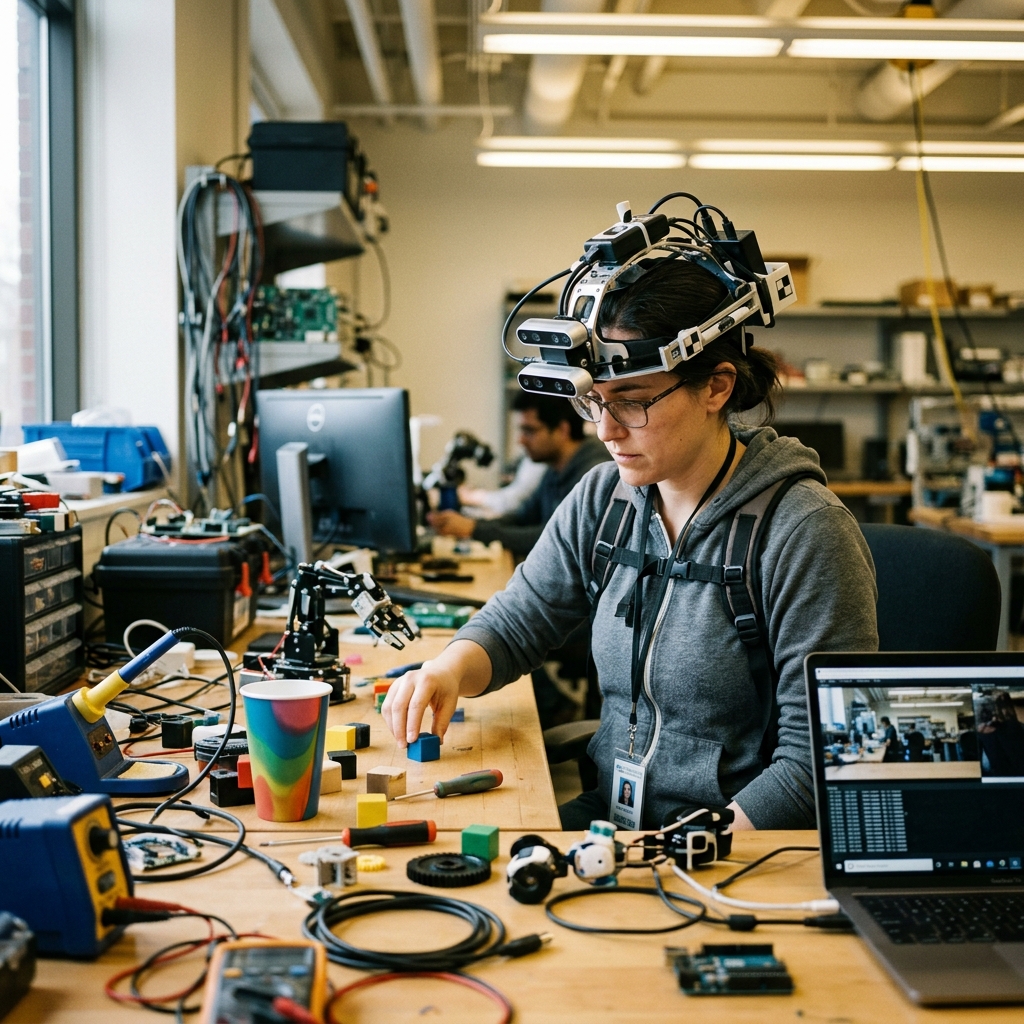
The most effective way to teach a robot a complex task is through human demonstrations. Techniques like teleoperation or kinesthetic teaching allow a human expert to guide the robot through a task, generating highly informative data.
Organizations developing advanced robotic manipulation heavily rely on this approach. By recording the sensor data and the corresponding human-guided actions, researchers can use imitation learning to train neural networks to replicate the behavior.
However, human demonstrations are costly to scale. Collecting enough diverse demonstrations to teach a robot to perform a task in any environment is one of the greatest bottlenecks in modern robotics.
The Challenge of Long-Horizon Tasks and Edge Cases
A robot's ability to pick up an object from a table is an impressive feat of engineering. However, real-world utility requires robots to perform sequences of actions to achieve a larger goal. These are known as long-horizon tasks.
The Complexity of Long-Horizon Tasks
Imagine asking a robot to "make a cup of coffee." This seemingly simple instruction involves a massive sequence of sub-tasks: navigating to the kitchen, opening the cabinet, finding the coffee, operating the machine, and serving the cup.
In robotics data, long-horizon tasks present a compound error problem. If the AI is 99% accurate at picking up the mug, but fails to properly align it with the coffee machine, the entire task fails. Robotics datasets must not only capture individual skills but also the transitions and strategic reasoning required to chain these skills together over extended periods. Current datasets are often heavily skewed towards short, isolated skills, leaving a critical gap in the data needed for true physical autonomy.
Navigating Edge Cases in the Physical World
In the digital world, an edge case might result in a weirdly formatted text response. In the physical world, an edge case can result in a broken robot, damaged property, or compromised human safety.
The physical world is infinitely varied. Lighting conditions change, objects are knocked over, and humans act unpredictably. Robot learning data must encompass an enormous variety of these edge cases. If a robot is only trained on data collected in a brightly lit laboratory, it will inevitably fail when deployed in a dimly lit warehouse. Capturing these long-tail events—the rare, unexpected scenarios that occur in the real world—is essential for building robust and reliable physical AI.
Data Diversity: The Missing Ingredient in AI Robotics Data
Generalization—the ability of an AI to apply what it has learned to new, unseen situations—is the holy grail of machine learning. For physical AI, generalization requires extreme data diversity.
Currently, many robotics datasets are hyper-specific. They are collected using a single robot model, performing a specific set of tasks, in a single environment. An AI trained on this data will overfit to those exact conditions. If you change the robot's gripper, alter the background color, or ask it to manipulate an object it has never seen, it will likely fail.
To achieve general-purpose robotics, we need datasets that are diverse across multiple axes:
- Environment Diversity: Data must be collected in kitchens, factories, hospitals, and outdoors, capturing varied lighting, backgrounds, and spatial layouts.
- Object Diversity: The robot must interact with objects of different shapes, sizes, weights, materials (rigid, deformable, transparent), and textures.
- Task Diversity: The data should encompass a wide range of skills, from pushing and grasping to folding, inserting, and dynamic throwing.
- Hardware Diversity: Ideally, datasets should span multiple robot morphologies (robotic arms, quadrupeds, humanoids) to enable cross-embodiment learning. Initiatives like the Open X-Embodiment dataset are pioneering efforts in this direction, aiming to pool data across different robot platforms to train more generalizable models.
Real-World vs. Simulated Data
Given the immense cost and difficulty of collecting real-world data, the robotics community has turned heavily to simulation. Simulated environments (like NVIDIA's Isaac Sim or MuJoCo) allow researchers to generate massive amounts of synthetic data quickly, safely, and cheaply.
The Power of Simulation
In simulation, a robot can attempt a task millions of times in parallel, accelerating reinforcement learning. Furthermore, simulation provides perfect ground truth data—you know the exact physical properties and locations of every object without dealing with sensor noise.
The Sim-to-Real Gap
However, simulation is not a silver bullet. The fundamental challenge is the sim-to-real gap. No simulation, no matter how advanced, can perfectly replicate the complex physics of the real world. Contact dynamics, friction, soft body deformation, and sensor noise are notoriously difficult to simulate accurately.
If a robot learns a policy entirely in simulation, it often fails when deployed on real hardware because the real world behaves differently than the simulator. While techniques like domain randomization (randomizing the physics parameters in simulation to make the policy more robust) help bridge this gap, real-world data remains indispensable.
The future of robotics training data lies in a hybrid approach: using simulation for large-scale pre-training and exploration, combined with high-quality real-world data for fine-tuning and capturing the subtle nuances of physical interaction.
Why Data Quality Matters
In the realm of LLMs, there is a prevailing philosophy that more data is always better. However, in physical AI, data quality often trumps data quantity.
Poor quality robotics datasets can actively harm a robot's learning process. For example, if human demonstrations are inconsistent, jerky, or sub-optimal, the AI will learn these bad habits. If the sensor data is improperly calibrated, the robot will develop a skewed perception of reality.
High-quality data must be:
- Accurate and Calibrated: Sensors must be perfectly aligned, and kinematic data must be precise.
- Contextually Rich: The data should include all necessary modalities (vision, proprioception, tactile) to fully describe the state of the world.
- Expertly Annotated: When human demonstrations are used, they must represent optimal, efficient solutions to the tasks.
- Cleaned and Filtered: Outliers, failed attempts (unless specifically labeled for negative reinforcement), and corrupted data must be removed to prevent the model from learning incorrect behaviors.
Investing in rigorous data curation pipelines is just as important as the collection process itself.
How Better Datasets Improve Robot Learning
When we feed high-quality, diverse robot training data into modern AI architectures, the results are transformative.
- Robustness and Reliability: Better data exposes the AI to a wider range of states, making the resulting policies more robust to disturbances and edge cases. A robot trained on diverse data is less likely to freeze or behave erratically when encountering a new situation.
- Faster Adaptation: Models trained on broad, high-quality datasets develop strong prior knowledge about the physical world. This allows them to adapt to new tasks or environments much faster, often requiring only a few targeted demonstrations to learn a new skill (few-shot learning).
- Emergent Capabilities: Just as LLMs developed emergent reasoning capabilities at scale, robots trained on massive, diverse datasets are beginning to show signs of emergent physical understanding, transferring skills learned in one domain to completely novel situations.
The transition from specialized, single-task robots to general-purpose physical AI is entirely dependent on the data we use to train them. By focusing on the quality, diversity, and physical grounding of our datasets, we can unlock the true potential of embodied artificial intelligence.