Introduction
As artificial intelligence moves from the digital realm into the physical world, the demands on data have fundamentally shifted. Large Language Models (LLMs) and standard computer vision models rely on massive, largely unstructured or loosely annotated datasets, such as vast text corpora or billions of 2D image-text pairs scraped from the internet. However, training physical AI—robots that must safely and autonomously interact with dynamic, unpredictable environments—requires a level of precision, temporality, and spatial awareness that traditional annotation pipelines simply cannot support.
The journey from a raw video stream, often collected via human teleoperation or passive human demonstration, to a pristine, robot-ready training dataset is intricate and resource-intensive. It is no longer just about drawing a bounding box around an object in a static frame. Modern robotics data annotation involves dense temporal segmentation, precise hand tracking, kinematic pose information mapping, multi-view synchronization, and rigorous quality assurance protocols.
When a robot fails to execute a task in the real world, the root cause can frequently be traced back to the data. Ambiguous labels, temporally misaligned events, or inaccurate spatial bounding can confuse even the most advanced learning algorithms. This article explores the entire robotics data annotation pipeline, detailing how raw, noisy sensor data is transformed into the highly structured formats required for modern imitation learning, reinforcement learning, and foundation models in robotics.
The Anatomy of Robotics Data: Beyond Bounding Boxes
In standard computer vision tasks, such as image classification or object detection, a single isolated frame is often sufficient to derive meaning. In robotics, data is fundamentally continuous and embodied. An action unfolds over time in three-dimensional space, meaning spatial annotations must be tracked temporally, and the state of the environment must be recorded at every tick of the system clock.
Raw Video and Multi-Modal Sensor Streams
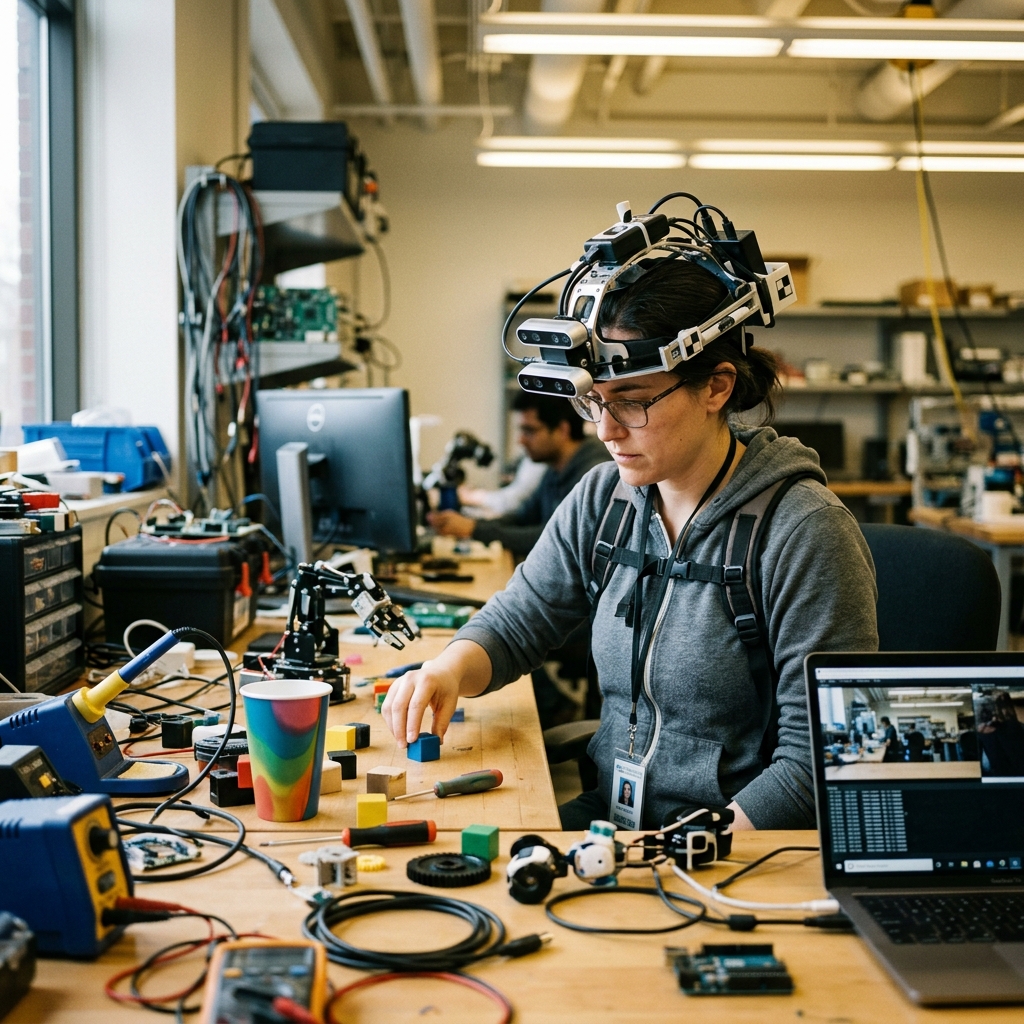
Robotics datasets usually begin as raw, multi-modal streams. To capture the full context of a scene, data is frequently collected at 30 to 60 frames per second from multiple vantage points simultaneously. These setups typically include:
- Wrist-mounted cameras (Egocentric view): Crucial for fine manipulation and understanding the exact relationship between the end-effector and the object.
- Head-mounted or chest-mounted cameras: Providing a broader view of the workspace and the robot's immediate surroundings.
- Third-person external cameras: Offering global context that helps the model understand spatial relationships that might be occluded in egocentric views.
In addition to standard RGB video, the raw data payload often includes:
- Depth maps (RGB-D): Providing necessary 3D spatial information natively.
- Proprioceptive data: High-frequency recordings of the robot's internal state, including joint angles, velocities, and motor torques.
- Haptic and force-torque sensor readings: Capturing the physical resistance and contact forces experienced during manipulation.
The central challenge of the data annotation pipeline in this domain is synchronizing these disparate raw streams and overlaying human-interpretable labels that a machine learning model can use to map visual states directly to physical actions.
Action Labels vs. Object Labels
Traditional computer vision relies heavily on object labels—for instance, identifying that a "mug" is present in the frame. While identifying objects is a necessary first step for robotics, it is not sufficient for action generation.
Robots require action labels. An action label defines exactly what the agent is doing to the object over a specific continuous timeframe. For example, rather than just labeling a mug, the timeline must be labeled with actions such as "reaching for the mug," "grasping the handle," "lifting the mug," and "pouring water." These action labels provide the semantic grounding that allows a model to understand intent and execution rather than just presence. They teach the model the temporal grammar of physical tasks.
The Core Annotation Pipeline
Transforming raw video and sensor data into pristine training data involves several sequential, highly specialized annotation stages. Each stage requires specific tooling and trained annotators who understand the physics of the tasks being performed.
Temporal Segmentation and Task Boundaries
The first critical step in processing continuous video is temporal segmentation. Annotators scrub through long, unedited video files to identify where a specific task begins and ends, establishing the exact task boundaries.
Consider a raw video containing an hour of a human demonstrator cooking a meal. Temporal segmentation breaks this continuous stream down into discrete, manageable, and highly specific episodes:
00:01:12:15 - 00:01:45:00: Chopping carrots00:02:10:05 - 00:02:30:20: Stirring the pot00:05:00:00 - 00:05:15:10: Wiping the counter
Accurate task boundaries are critical for model convergence. If the boundary is too wide, the model ingests irrelevant pre- and post-task idle behaviors, which can lead to hesitation or wandering in the deployed robot. If the boundary is too narrow, the model might miss the critical approach vectors or release phases of a manipulation task, preventing it from ever successfully initiating the action.
Identifying Events and State Changes
Within a segmented task, annotators must identify highly specific events. Events are instantaneous points in time (often localized to a single frame) where the state of the world or the relationship between the robot and the environment fundamentally changes.
Common robotics events that require precise labeling include:
- Contact: The exact frame a hand, tool, or end-effector makes physical contact with an object.
- Grasp: The moment an object is firmly held, its weight is supported, and it is coupled to the movement of the hand.
- Release: The exact moment physical contact is broken and the object becomes independent of the agent.
- State Change: When an object physically transforms. This could be an egg cracking, a button clicking into a pressed state, a door latching shut, or a flexible material like cloth folding.
Marking these events allows models to learn the critical transitional phases of a task. These transitions are often the hardest parts of a control policy to learn, as they involve sudden shifts in dynamics and forces.
Pose Information and Hand Tracking
For imitation learning—especially when training models from unstructured human demonstrations—the neural network must learn to map human kinematics to robot kinematics. This requires dense and highly accurate pose information.
Annotators, frequently assisted by automated pre-labeling models, track the 3D position and orientation (the 6-DoF pose) of both the human hands and the objects being manipulated throughout the trajectory.
- Hand Tracking: Identifying the specific joints and digit placements of the human hand to understand the grasp taxonomy (e.g., distinguishing between a precision pinch grasp, a power cylindrical grasp, or a lateral key grasp).
- Object Pose: Tracking how an object moves through space relative to both the camera frame and the manipulator's frame of reference.
- Kinematic Mapping: Documenting how the degrees of freedom in the human arm relate to the target robotic embodiment.
This pose data is the foundational requirement for retargeting, a complex process where a human's hand trajectory is mathematically translated into a trajectory that a robot arm with a entirely different physical embodiment (such as a two-finger parallel jaw gripper or a multi-fingered dexterous hand) can execute.
Metadata and Contextual Labels
To make datasets searchable, filterable, and useful for conditioned generation, the data must be enriched with robust metadata. Metadata provides the necessary context for model conditioning. If a modern foundation model for robotics is prompted by a user to "pick up the red block and avoid the blue one," the text prompt itself is metadata that must be mathematically linked to the visual and proprioceptive trajectory.
Vital metadata includes:
- Environmental Context: The setting of the task (e.g., industrial kitchen, warehouse floor, residential living room).
- Lighting and Conditions: Annotating whether the scene is well-lit, suffers from glare, or has heavy shadows, which helps in training models that are robust to domain shifts.
- Trajectory Status: The perceived success or failure of the demonstration. Surprisingly, failed demonstrations (where a human drops an object or misses a grasp) are highly valuable for offline reinforcement learning, as they teach the model what not to do and how to recover from errors.
- Language Grounding: Textual descriptions of the task at various levels of granularity, from high-level goals ("make a cup of coffee") to low-level primitives ("move gripper 5cm forward").
A Realistic Example: The "Pick and Place" Pipeline
To illustrate how these disparate components come together in practice, let's trace a realistic example of a ubiquitous robotics task: picking up a wrench and placing it in a toolbox.
1. Raw Video Ingestion
A human teleoperator uses a Virtual Reality (VR) rig to remotely control a robotic arm in a lab. The system records three synchronized camera feeds (wrist camera, left shoulder, right shoulder) at 30 FPS, along with the robot's joint angles, velocities, and gripper states, producing a continuous 5-minute raw data file. During this time, the operator attempts to pick up the wrench, drops it once by accident, repositions the arm, picks it up successfully on the second try, and places it in the toolbox.
2. Temporal Segmentation
An annotator reviews the 5-minute video stream. They segment out the failed first attempt (labeling it with the metadata trajectory_status: failed) and carefully isolate the successful attempt.
- Start Boundary: The exact frame the robot arm begins its initial movement toward the wrench from a resting state.
- End Boundary: The frame the arm fully retracts and comes to a stop after releasing the wrench into the toolbox.
3. Dense Annotation
Within the boundaries of the successful trajectory, the annotator applies dense labels across the timeline:
- Object Labels: 3D bounding cuboids are drawn around the "wrench" and the "toolbox." To save time, these are drawn every 10 frames, with interpolation algorithms filling in the gaps. The annotator scrubs through to verify the interpolated boxes don't drift.
- Action Labels: The timeline is divided into discrete, contiguous phases:
[approach_wrench] -> [grasp_wrench] -> [lift_wrench] -> [move_to_toolbox] -> [release_wrench]. - Events: The exact, single frames for
contact_madeandcontact_releasedare tagged. - Pose Tracking: The 6-DoF pose of the robot's gripper relative to the wrench's center of mass is verified and manually corrected if the automated tracking drifted during the fast movement phase.
4. Quality Control (QA)
The annotated trajectory passes to a secondary Quality Assurance reviewer. The QA reviewer notices that the grasp_wrench action label was started three frames before the contact_made event actually occurred. This temporal misalignment is flagged and corrected. If left uncorrected, the model might learn to close its grippers too early in the air, resulting in failed grasps during real-world deployment.
5. Dataset Consolidation
The perfectly annotated, QA-approved trajectory is combined with 10,000 other similar "pick and place" demonstrations involving various tools and receptacles. The data is serialized into a highly efficient, chunked format (like HDF5, WebDataset, or TFRecord), perfectly aligning the video frames with the proprioceptive state arrays, action labels, and textual metadata.
6. Training and Deployment
A physical AI architecture—such as a Diffusion Policy model or an Action Chunking with Transformers (ACT) network—ingests this massive, structured dataset. Because the temporal segmentation is tight, the event markers are precise, and the poses are accurate, the model successfully learns a robust, generalized policy that can identify, approach, pick, and place a novel wrench in an unseen environment.
Quality Assurance and Dataset Integrity
In physical AI, the cost of failure is high. Bad data doesn't just result in a slightly lower accuracy metric on a validation chart; it results in a 50-pound robot arm smashing a plate, damaging its own hardware, or posing a safety risk. Quality assurance in the robotics annotation pipeline is therefore arguably the most critical step of the entire process.
Inter-Annotator Agreement (IAA)
To ensure consistency across massive datasets annotated by distributed teams, pipelines continuously measure Inter-annotator agreement (IAA). This metric quantifies how often multiple independent annotators make the exact same decisions on the same piece of data.
In robotics, calculating IAA is highly complex. It's not just a binary check of whether two people agree an object is a wrench. It involves measuring spatial Intersection over Union (IoU) for bounding boxes in 3D space, and temporal variance for event tagging (e.g., do both annotators agree the grasp event happened on frame 342, or did one mark it at frame 345?). High IAA is the bedrock of dataset consistency; if different annotators label the exact same behavior differently, the model receives conflicting reward signals or imitation targets, inevitably leading to erratic and unpredictable robot behavior.
Common Annotation Errors in Robotics
Experienced QA teams specifically look for common failure modes unique to robotics annotation:
- Temporal Drift: Action labels bleeding into adjacent, unrelated actions due to annotator fatigue or sloppy scrubbing.
- Causal Confusion: Annotating a reaction as if it were the cause. For example, labeling the movement of a block a few frames before the robot hand actually applies physical force to it. This teaches the model broken physics.
- Spatial Misalignment and Occlusion Failures: Bounding boxes or pose estimates that drift off the target object during fast motion or heavy occlusion. This is incredibly common in manipulation tasks when the robot's hand or arm fully covers the object being manipulated.
- Missing State Changes: Failing to label when an object's physical state changes, making it impossible for the model to learn the consequence of its actions (e.g., turning a knob without logging that the door is now 'unlatched').
Ensuring Dataset Consistency Through Ontologies
Maintaining dataset consistency at scale requires strict, unambiguous ontological guidelines. Teams must answer hyper-specific questions: What exactly defines a "pick"? Does the object need to completely clear the table surface, or is supporting 100% of its weight while it still touches the table enough?
These definitions must be documented exhaustively in an annotation manual. Furthermore, modern annotation pipelines enforce these rules programmatically. Automated QA scripts can run over the data before human review, instantly flagging logical impossibilities—such as a release_object event occurring in the timeline without a preceding grasp_object event, or an object's bounding box moving at high velocity without the robot arm being in physical contact with it.
Conclusion
The data annotation pipeline for robotics represents a sophisticated, multi-disciplinary engineering challenge. It requires the AI industry to move beyond the paradigm of static 2D images and text, stepping into the realm of continuous, multi-modal, and temporally sensitive physical workspaces.
By meticulously tracking object poses, strictly defining task boundaries, carefully logging kinematic states, and enforcing uncompromising quality assurance protocols, data annotation teams provide the critical foundation required for physical AI. It is this high-fidelity, highly structured data that will finally allow robots to step out of heavily controlled simulations and safely, autonomously, and effectively execute useful tasks in the chaotic reality of the human world.